

What Happens When a Live Casino Dealer Makes a Mistake?
For most players, the tension of a live casino is not the size of a bet, but the knowledge that every action at the table is being carried out by a person in real time. For a related reference on the financial side, mino casino can add useful context. There is no shuffle animation cutting corners and no card flip that can be instantly undone without a trace. That human pace is often what draws people to look for a table to sit at in the first place, and for those still sizing up which one to pick, taking a moment to check can be less about chasing anything and more about getting a feel for how unfiltered that pace actually is. The fact that a live casino runs on split seconds handled by hands, not just code, is precisely the reason the possibility of a slip never truly leaves the room.
• This is a break that would be impossible to notice in most automated games, yet it is a common enough sight for anyone who has watched enough tables inside a real casino to know the
• This level of restraint is not a matter of speed, but of procedure
• It is expected on a busy casino floor that mistakes are fixed on record for all to see, not brushed aside
• The reaction from players tends to be far more complicated than outrage
• Others lean in with a strange bit of curiosity, watching closer now that the illusion of flawlessness is gone
• An automated table will simply never place a card wrong on purpose and never have to own it in front of strangers
• The cold precision has its place, but it also has no weight to it
• It is done solely to keep the round valid as it was meant to be played, with no shortcuts taken in front of the people still seated for it
A Closer Look at Enough
The very moment a dealer makes a mistake, the first thing that happens is a break in rhythm. On many streams the chat may keep moving for a second, but at the table itself time seems to slow down. A card placed in the wrong spot, a payout counted too fast, or a decision announced a hair too soon is enough to jolt both the dealer and the players out of the autopilot that any long run of hands tends to create. This is a break that would be impossible to notice in most automated games, yet it is a common enough sight for anyone who has watched enough tables inside a real casino to know the difference between a practiced motion and a hesitant one.
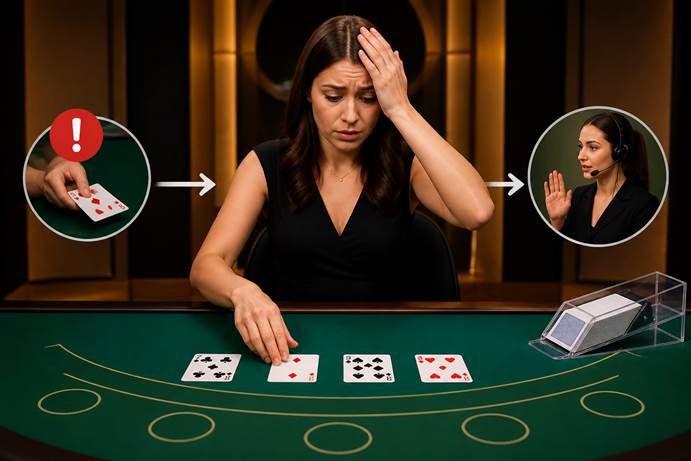
What follows is almost never panic. In most cases, the dealer will stop outright, point back to the exact action, and correct it before going any further. The cameras stay locked on, the cards stay visible, and the table is not rushed back into play to cover up what just occurred. This level of restraint is not a matter of speed, but of procedure. It is expected on a busy casino floor that mistakes are fixed on record for all to see, not brushed aside. The players at that table may be split between mild surprise and quiet attention, but there is rarely any attempt to hurry the person trying to put things back exactly as they should be. For a profession built around repetition, correcting a mistake in front of a full table is often the most deliberate thing a dealer will do all shift.
What to Know About Player Experience
The reaction from players tends to be far more complicated than outrage. Some players go rigid with caution, suddenly hyper aware of every card that is dealt from there on. Others lean in with a strange bit of curiosity, watching closer now that the illusion of flawlessness is gone. Very few expect the dealer to be perfect to begin with, but actually seeing the correction play out makes that fact concrete in a way words cannot. In any casino that puts a real person at the table, the unwritten contract is simple: the game is live, so the people running it are allowed to be human. The tension shifts from "will I win this hand" to "how will this be set right", and for a moment that change of focus is more gripping than the outcome itself.
|
Area |
What to know |
|
Context |
The very moment a dealer makes a mistake, the first thing that happens is a break in rhythm. |
|
Consideration |
The reaction from players tends to be far more complicated than outrage. |
|
Practical takeaway |
There is also a stark contrast to be drawn between this and the rest of the options available. |
There is also a stark contrast to be drawn between this and the rest of the options available. The appeal of a modern casino has expanded to cover countless forms of play, but only a live casino can produce this exact type of moment. An automated table will simply never place a card wrong on purpose and never have to own it in front of strangers. The cold precision has its place, but it also has no weight to it. By contrast, the weight here comes from the fact that the correction costs time, breaks momentum, and offers no flashy reward for doing it. It is done solely to keep the round valid as it was meant to be played, with no shortcuts taken in front of the people still seated for it.
Goes, Casino Experience, and the User Experience
For all the polish that goes into the lights, cameras and layout of a large casino, these unguarded seconds expose more about the job than hours of flawless dealing ever could. A dealer who can stop themselves, hold their ground, and put a mistake right without posturing shows a kind of discipline that is easy to miss when every hand glides by. It does not make the mistake desirable, and no one at the table is hoping for the next one. Yet for players who value the fact that what they are watching is genuinely live, this small act of accountability is quietly reassuring. In the end, the thing that keeps pulling people back to a casino table time and time again is not perfection, but the rare knowledge that if something slips, there is still a real person there with enough composure to fix it before the next card goes down.
